
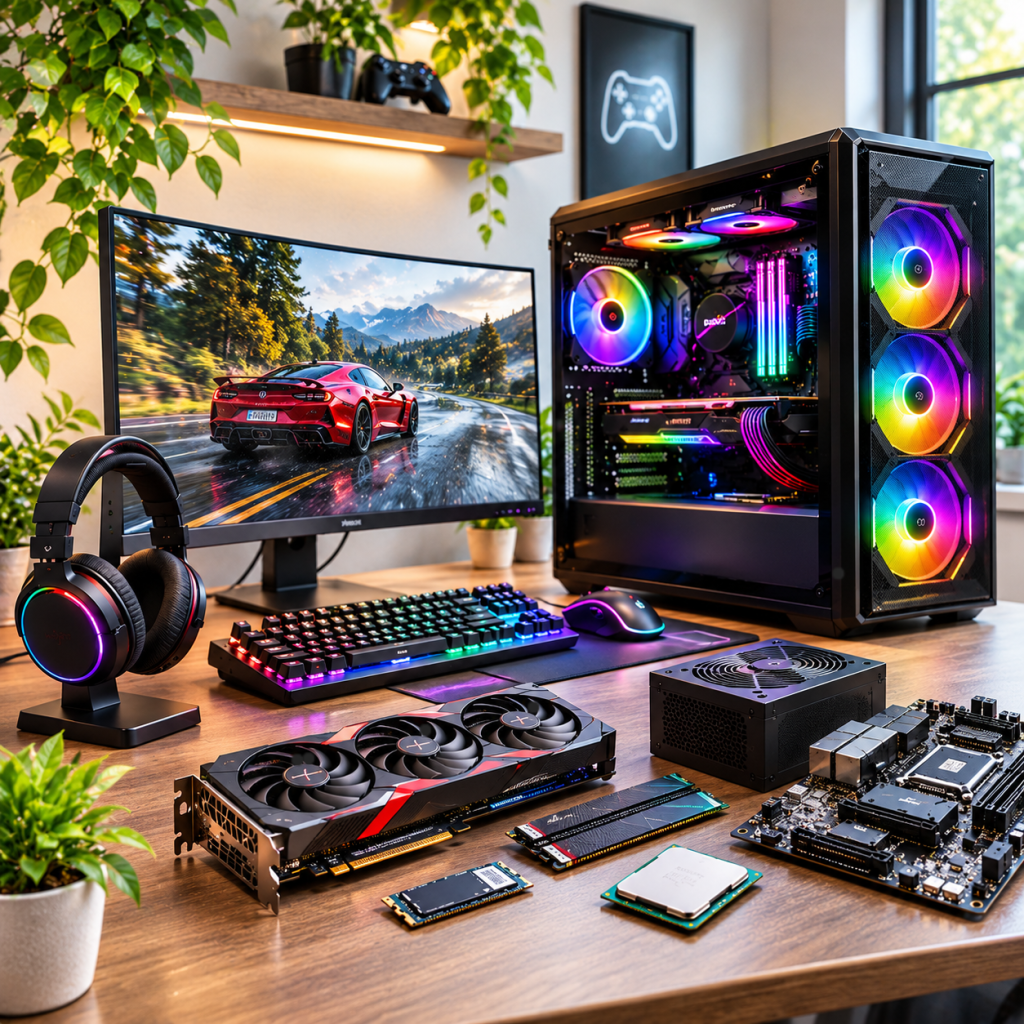
Building a gaming PC yourself brings a kind of excitement. You begin with a budget, a games you want to play and a long list of parts. Then you quickly learn that picking the graphics card is only half of the work. The processor must match the GPU the power supply must give extra power the case must hold all the parts and cooling can decide whether the machine runs nicely or sounds like a small airplane all the time.
The good news is you do not need to spend thousands of pounds to build a capable gaming PC. The trick is knowing where your money is most important and where it is easy to overspend. This guide explains custom gaming PC builds from budget systems to mid‑range and high‑end machines. It explains what each part does. Shows how to assemble a balanced build instead of just buying the most expensive parts you can find.

A good gaming PC is not always the one with the numbers on a spec sheet. Often the best performance comes from a balanced system. All the parts need to work. If one part is too powerful. The others can’t keep up the whole system suffers.
The graphics card or GPU is usually the important. It handles the visuals. Runs the game at high resolutions and detailed settings. A strong GPU means gameplay and better image quality.
The processor or CPU does the lifting for game logic and background tasks. A fast CPU prevents stutters. Keeps frame rates high. It also helps with multitasking.
RAM is another piece. 16GB is a base, for most games today.. 32GB is becoming more useful especially for newer games and if you’re editing videos or streaming while you play.
Storage matters a lot too. An NV Me SSD makes games load fast. The system feel responsive. Games take up a lot of space so having enough storage is important.
The power supply or PSU is often overlooked.. It’s vital. You need an unit with enough wattage to power everything. Cheap PSUs can. Cause problems. It’s not worth saving a dollars here.
Cooling is also important. Good airflow and a solid CPU cooler keep temperatures down. This helps the system stay stable during gaming sessions. Overheating can slow things down. Even cause crashes.
Finally the motherboard connects everything. It needs to support your CPU, RAM, storage and future upgrades. Choose one that fits your needs and gives room to grown
Choosing compatible components is only one part of building a reliable system. Proper testing and professional laptop repair and support in London can also help identify hardware issues that affect gaming performance.
A good gaming PC balances all these parts. No single component should hold the others back. Think about what you want to do with it—gaming, streaming, content creation—. Build around that.
For people this is the perfect range to get into PC gaming without spending too much money. At this price point the goal is not to build a top-tier 4K machine. It is to create a 1080p gaming PC that runs popular competitive games smoothly and handles most modern games at good settings.
A good budget build should focus on the graphics card first. Pick a mid-range processor that offers strong performance without using up too much of the budget. Try to include around 16GB of RAM and a 1TB NV Me SSD. These components give you power and storage now and leave room for upgrades later if your game collection grows.
Component | Recommended Specification | Purpose / Key Consideration |
Processor (CPU) | AMD Ryzen 5 5500 or Ryzen 5 5600 (6-core) | Provides reliable processing performance for 1080p gaming and everyday multitasking. Choose according to current prices and motherboard compatibility. |
Graphics Card (GPU) | NVIDIA GeForce RTX 5050, AMD Radeon RX 7600 or a competitively priced alternative | Handles game graphics and has a major impact on gaming performance. Compare gaming benchmarks, video memory and current prices before choosing. |
Memory (RAM) | 16GB DDR4 (2 × 8GB, dual-channel) | A sensible starting point for budget gaming. Dual-channel memory supports balanced system performance. |
Storage | 1TB NVMe SSD (500GB as a temporary budget option) | Provides fast boot times, responsive system performance and sufficient space for Windows, applications and several games. |
Motherboard | Compatible B550 motherboard | Suitable for Ryzen 5000-series DDR4 processors. Check CPU support, memory compatibility and available upgrade options. |
Power Supply (PSU) | Reliable 550W–650W unit from a reputable manufacturer | Supplies stable power to the system. Check the selected graphics card’s power requirements before purchasing. |
Cooling | Stock CPU cooler or affordable air cooler | Helps maintain suitable processor temperatures without using too much of the budget on expensive cooling. |
PC Case | Airflow-focused case with a mesh front panel | Supports ventilation, provides graphics card clearance and allows room for additional fans. |
RGB Lighting | Optional | Decorative lighting is not essential for gaming performance. Prioritise hardware quality and cooling instead. |
Budget Area | Recommendation |
Total Budget | £600–£800 |
Target Resolution | 1080p gaming |
Main Priority | Graphics card performance |
Processor Priority | Balanced six-core CPU |
Memory Priority | 16GB DDR4 |
Storage Priority | 1TB NVMe SSD, if budget allows |
Power and Cooling | Reliable PSU and good case airflow. |
Future Upgrades | Additional RAM, storage or graphics card, depending on compatibility |
Budget Exclusions | Monitor, keyboard, mouse and Windows licence may require a separate budget |
You can also save money by skipping things you don’t really need. A flashy RGB case, a motherboard, with features you’ll never use or a large liquid cooler might look cool but they don’t help with gaming performance. That money is better spent on parts that actually make your games run better.
Even with a limited budget, it is important to choose reliable components and avoid unnecessary hardware problems. If your existing system is experiencing faults, professional PC repair in London may help you identify the issue before investing in a completely new build.

16GB RAM: The 16GB RAM provides a starting point in many gaming scenarios and you can move to 32GB later.
1TB NV Me SSD: The 1TB NV Me SSD offers a capacity for Windows and a selection of games so you do not need a second drive right away.
Reliable PSU: Choose a power supply and do not cut corners just to save a small amount.
Airflow case: Good ventilation matters more, than a flashy design.
This is where building a custom PC gets really interesting. A mid-range system can give great 1080p performance and good 1440p gaming depending on the graphics card you pick. It is also the place where you can start building around a monitor, refresh rate and game collection instead of just trying to get the cheapest working system.
For a system in this range 32GB of RAM is a goal if the budget allows especially if you stream, edit video have many apps running or want more space for upcoming games. A 1TB or 2TB NVMe SSD can be better than getting a drive now and changing it later.
Component | Recommended Specification | Purpose & Key Considerations |
Processor (CPU) | AMD Ryzen 5 7600-class or comparable modern Intel Core i5 | Provides a strong foundation for higher processing power, 1440p gaming, and multitasking based on platform choice. |
Graphics Card (GPU) | AMD Radeon RX 9060 XT 16GB or NVIDIA GeForce RTX 5060-class | Handles main game graphics. Pay close attention to VRAM and 1440p resolution benchmarks, pricing, and game requirements. |
Memory (RAM) | 32GB DDR5 | Offers a more flexible and future-proof system where platform and budget allow. |
Storage | 1TB NVMe SSD (2TB optional) | 1TB serves as a practical starting point, with 2TB recommended for larger modern game collections. |
Motherboard | Feature-rich platform motherboard | Provides useful connectivity, additional M.2 storage expansion slots, and a clear long-term upgrade path. |
Power Supply (PSU) | Quality 650W unit (or higher based on GPU/CPU requirements) | Delivers clean power; total wattage should always be verified against chosen CPU and GPU load requirements. |
Cooling | Capable tower air cooler | Maintains stable system temperatures efficiently without unnecessary spending on premium cooling accessories. |
PC Case | Well-ventilated case | Ensures continuous airflow for temperature stability and system component longevity. |
Planning Area | Recommendation / Guideline |
Target Resolution | 1440p gaming focus with adequate graphics VRAM |
Core Focus | Balance graphics performance, memory, and storage needs |
CPU Selection Strategy | Prioritize real GPU performance over the most expensive processor |
Platform Longevity | Invest in solid motherboard connectivity and extra M.2 slots for future upgrades |
Cooling Strategy | Use effective air cooling and ventilated cases to save budget for core components |
The processor needs to be powerful enough to keep the graphics card working without paying for performance you won’t see at your chosen resolution. This is also a time to think about better CPU cooling and a motherboard that has good options, for future upgrades.
Once you move into high-end territory the goal changes. You are no longer simply looking for the frame rates possible for the money. You may be targeting high-refresh-rate 1440p, 4K gaming, demanding ray-traced titles, VR, streaming or a machine that can handle gaming and professional workloads at the time.
A high-end build can include a current-generation CPU, a top-tier graphics card, 32GB or 64GB of fast memory multiple NVMe SSDs and a more sophisticated cooling setup. The case and PSU become especially important because high-performance components generate heat and can demand considerably more power.
Component | Recommended Specification | Purpose & Key Considerations |
Graphics Card (GPU) | NVIDIA GeForce RTX 5070 Ti-class or AMD Radeon RX 9070 XT-class | Top priority for demanding 1440p high-refresh or 4K gaming. Choose based on target games, resolution, and feature needs. |
Processor (CPU) | AMD Ryzen 7 X3D-series or high-performance Intel Core processor | Complements GPU for demanding gaming, streaming, or video editing. Select according to main workload rather than price alone. |
Memory (RAM) | 32GB DDR5 (64GB for heavy workloads) | 32GB ideal for high-performance gaming; 64GB recommended for content creation, heavy multitasking, and specialized tasks. |
Storage | Fast 2TB NVMe SSD + optional secondary drive | 2TB primary SSD for fast access, plus an additional drive for expanded game libraries, high-res recordings, and project files. |
Power Supply (PSU) | 750W–850W quality unit (or higher for power-hungry builds) | Ensures stable power delivery. Always check and follow graphics card manufacturer’s recommended wattage guidelines. |
Cooling | Capable air cooler or liquid cooling system (AIO) | Manages thermal output during sustained heavy workloads to ensure system stability and performance. |
PC Case | High-airflow case with GPU & radiator clearance | Must offer adequate dimensions for long GPUs, radiator mounting, and clear intake/exhaust airflow channels. |
Planning Area | Recommendation / Checklist Requirement |
Performance Target | Optimize for 1440p high-refresh or 4K gaming target rather than an uncapped budget |
Build Balance | Achieve balance between raw performance, system reliability, acoustics, and future upgradability |
Pre-Purchase Checks | Verify motherboard compatibility, RAM speed/clearance, GPU dimensions, CPU cooler height, PSU connectors, and M.2 slots |
Value Allocation | Invest in extra hardware only when it yields tangible performance benefits for target workloads |
At this level it is easy to spend money simply because a component is marketed as premium. High-performance systems also need careful monitoring to maintain stability during demanding workloads. If your gaming PC develops a fault or requires technical troubleshooting, Emergency PC Repair can be a relevant service to explore.
The better approach is to identify the workload first. If your monitor is 1080p, at 60Hz, a £2,500 gaming PC may be difficult to justify. If you are gaming at 4K with a high-refresh-rate display the extra investment can make more sense.
It is the question: “What am I actually going to use it for?” This is the part of a custom build that people often overlook. Two people who have the budget can need completely different PCs.
A competitive player who mainly plays esports titles may find a CPU, a monitor with a high refresh rate and a responsive PC more useful, than a huge graphics card.
Someone who plays visually demanding single‑player games at 4K should put a share of the budget on the GPU. A streamer or video editor may need CPU power, more RAM and more storage.
Spending too much on the CPU: For a gaming-focused machine, an expensive processor paired with a weak A graphics card can create a build.
Choosing a PSU: A power supply is responsible for delivering power to every major component. Reliability matters more than features.
Forgetting airflow: A powerful PC still needs to move air out and cool air in. Poor airflow can lead to temperatures and unnecessary fan noise.
Buying parts: CPU socket, motherboard support, RAM type, case dimensions and PSU connectors all need to be checked before ordering.
Ignoring upgrade paths: A little planning can make future upgrades much easier. Consider storage slots, RAM capacity and motherboard features.
Overspending on RGB: Lighting can look great. It does not increase FPS. Put the performance budget into the components that actually affect your games.
A London gamer wants to move from console gaming to PC. He has around £1,200 to spend and initially plans to put most of the money into the graphics card. After checking the rest of the system, however, it becomes clear that the first draft includes a weak power supply, too little storage and a processor that does not make sense for the chosen GPU.
Rather than simply buying the most expensive graphics card available, a balanced custom build spreads the budget across a capable CPU, a suitable GPU, 32GB of memory, a 1TB NVMe SSD, a reliable PSU and a well-ventilated case. The result is a machine designed around actual gaming needs, with a sensible upgrade path rather than a collection of expensive parts that do not work particularly well together.
For gamers who are unsure about their system’s condition, professional remote technical support may also help with troubleshooting certain software, configuration and performance-related issues before considering hardware replacement. That is the practical advantage of a properly planned custom gaming PC: every pound is working towards the experience you actually want.
Tech Repair London offers computer and gaming PC support across London.
Tech Repair London handles gaming PC repairs and performance upgrades.
Tech Repair London provides collection, repair and return services.
Tech Repair London uses pricing, a No Fix No Fee. Gives a 12 month warranty on eligible repairs.
If you are building or upgrading a gaming PC professional help can be useful when compatibility problems, overheating, performance issues or upgrade choices become hard to diagnose. A assessed system can often be improved without replacing every component.
Tech Repair London also serves London areas such, as Kensington, Chelsea, Paddington, Camden, Marylebone, Hammersmith, Chiswick, Westminster, Battersea, Lambeth, Fulham, Ealing, Wimbledon, Islington and Shepherds Bush.
A basic gaming PC can start around £600–£800 while a solid mid‑range gaming PC can sit around £900–£1,400. High‑end gaming PCs can easily exceed £1,500. Reach £2,500 or more depending on components, resolution and performance target.
Gaming PC price ranges in the UK
CPU: AMD Ryzen 5 5600
GPU: Radeon RX 6600 / RX 7600
RAM: 16GB DDR4
Storage: 500GB–1TB NVMe SSD
PSU: 550W–650W
Resolution: 1080p
CPU: AMD Ryzen 5 7600 / Intel Core i5
GPU: NVIDIA RTX 4060 Ti / RTX 5060 Ti
RAM: 32GB DDR5
Storage: 1TB NVMe SSD
PSU: 650W–750W
Resolution: 1080p–1440p
CPU: AMD Ryzen 7 7800X3D / 9800X3D
GPU: NVIDIA RTX 5070 Ti / RTX 5080
RAM: 32GB DDR5
Storage: 2TB NVMe SSD
PSU: 850W Gold
Resolution: 1440p Ultra / 4K
Building a gaming PC yourself can give you control over parts and budget but the cheapest option is not always the best value. A professional build or assessment can help avoid compatibility mistakes, poor airflow, unsuitable power supplies and upgrades that do not deliver performance gains.
Sixteen gigabytes remains a starting point for many gaming PCs while thirty‑two gigabytes is increasingly attractive for newer games, multitasking, streaming and content creation. The right amount depends on how you use the gaming PC.
For a gaming‑focused gaming PC the graphics card often deserves the share of the budget. However the CPU still needs to be strong enough for targeted games and resolution so balance is more important than maximizing one component.
No. A good air cooler can be more than sufficient, for gaming PCs. Liquid cooling becomes more useful when you work with a high‑performance CPU want acoustic or aesthetic characteristics or need additional cooling capacity. The right choice depends on the gaming PC build.
Yes. This is one of the biggest advantages of a custom gaming PC. If the initial build uses a motherboard, power supply and case you can often add more RAM or storage and upgrade the graphics card later. Planning for those upgrades from the beginning can save money over time.
A custom gaming PC can still be great even if it is not the expensive machine in the room.
A £600–£800 build is a starting point. A £900–£1,400 system gives a mix of performance and value. A £1,500+ build gives the high‑end experience needed for 1440p 4K and enthusiast gaming.
The key is getting the balance right. Begin with the games you play the resolution you want and the budget you have. Then pick components that work well together of chasing flashy numbers, on product boxes.
If you are not sure whether your current gaming PC needs an upgrade, repair or complete rebuild Tech Repair London can assess the system. Suggest a practical way forward.